All posts by ProHobo

Unknown's avatar

About ProHobo

I am my thoughts......I think.

San Maria Bay

Sun 1 Feb 2015

Andre and I organised, with the same tuk tuk driver from yesterday, to take us to San Maria Bay. We climbed on the back and he first made a stop at a house in his neighbourhood. He told us, “Five minutes!” which we know means anything from 20 minutes to one hour. We quickly ducked into a local restaurant for avocado shakes.

Meanwhile, back at the tuk tuk we now had nine young girls on the back. One of them insisted on holding my ukulele and she did so for the whole day.

The drive there was rough! The road was long and in a terrible state. Sitting on a wooden bench does not improve the situation. We arrived at the pagoda, which was actually further than where we wanted to go. But it turned out to be a pleasant misunderstanding. The temple was right at the end of a small peninsula. The girls guided us through the temple and showed us how to pay respects to Buddha. They took us onto the rocks at the water’s edge and we just admired the turquoise scenery.
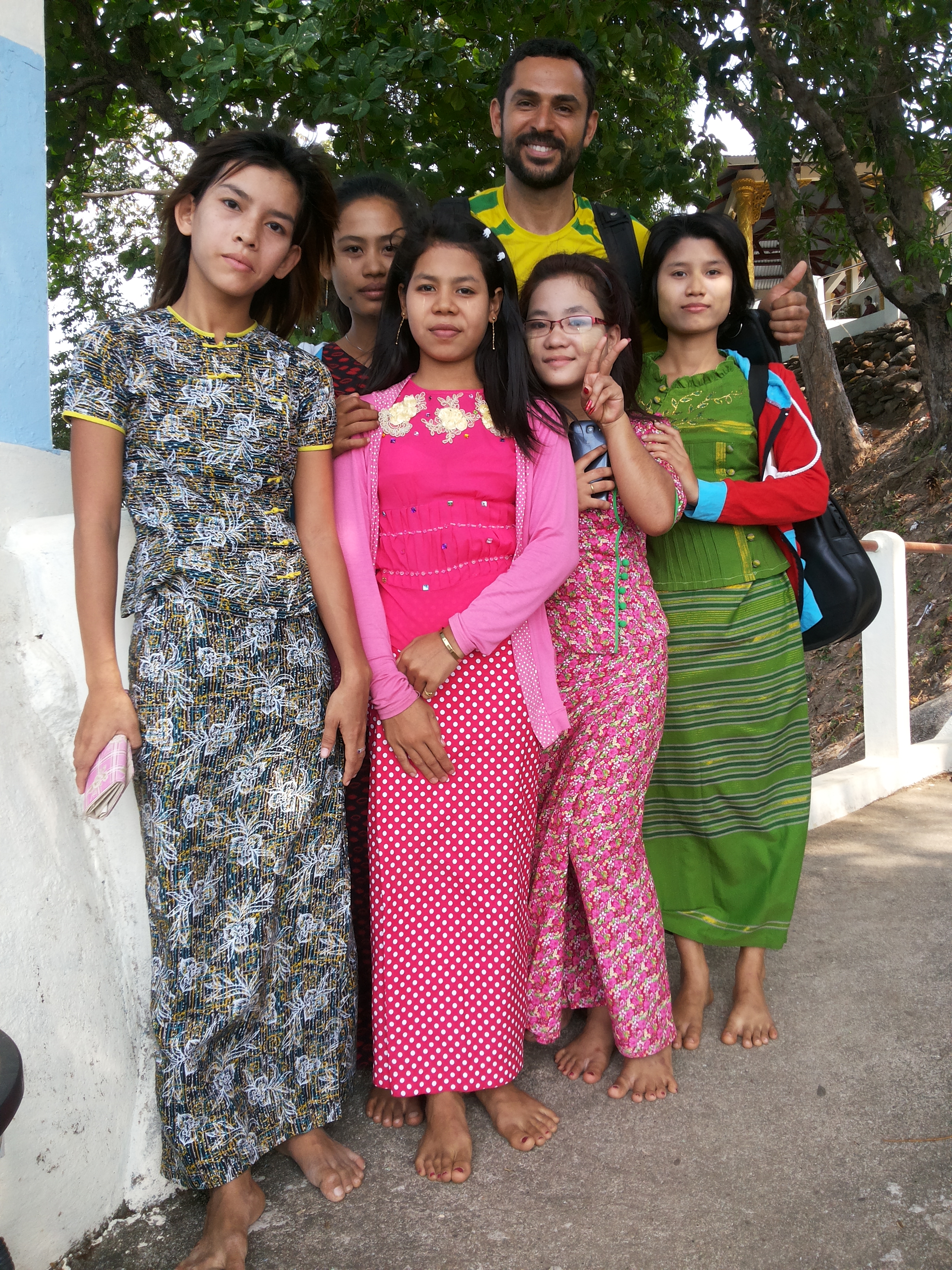
Andre and the girls at the pagoda

At one point I asked Andre how old he thinks the girls were. We guessed that they were anything between 12 and 14. We asked them through the use of cell phones and broken English. They were actually between 17 and 20. We were completely blown away and double checked by asking for their years of birth.

Monument on the water's edge
Monument on the water’s edge

Leaving the pagoda, the girls insisted on carrying our bags. Very strange, but they were persistent in having their way. We had lunch outside the pagoda, at a restaurant on the water’s edge. After some food Andre and I went for a swim in the small bay, where three fishing boats had anchored to offload their catch. We swam out to them and saw that they had hundreds of fish! Most were pan-sized, but some were bigger than me.

African on the rocks

There was literally no one on the beach, only local people in the pagoda and no other tourists. We walked on the beach with the girls while they collected shells and poked around in rock pools. One girl gave me a stick with dried periwinkles as a snack. I took a bite and said, “Hmmm…good” while hiding the urge to spit it out. I did not want to disappoint her. When no one was looking I threw the rest under a rock.

The surrounding area looked perfect, untouched and peaceful, although we knew that the ocean is heavily over-fished. We did not want to leave, as the sun was going down and the atmosphere was similar to a National Geographic documentary where they only use the best footage for the film. We guessed that the girls needed to be home soon and navigating these roads in the dark would not be safe.

The blind leading the blind

A few minutes down the gravel road, the tuk tuk halted and the girls ran, excitedly into the bush and started pointing at the trees. After a minute of complete cluelessness we realised that they were after the berries. Tasting them was an anticlimax and Andre actually spat one out.

Having the girls around was great. They are very different to westernised girls, their age. They seem more mature in ways and more naive in others. But these are only assumptions, as we could not communicate with them, unfortunately.

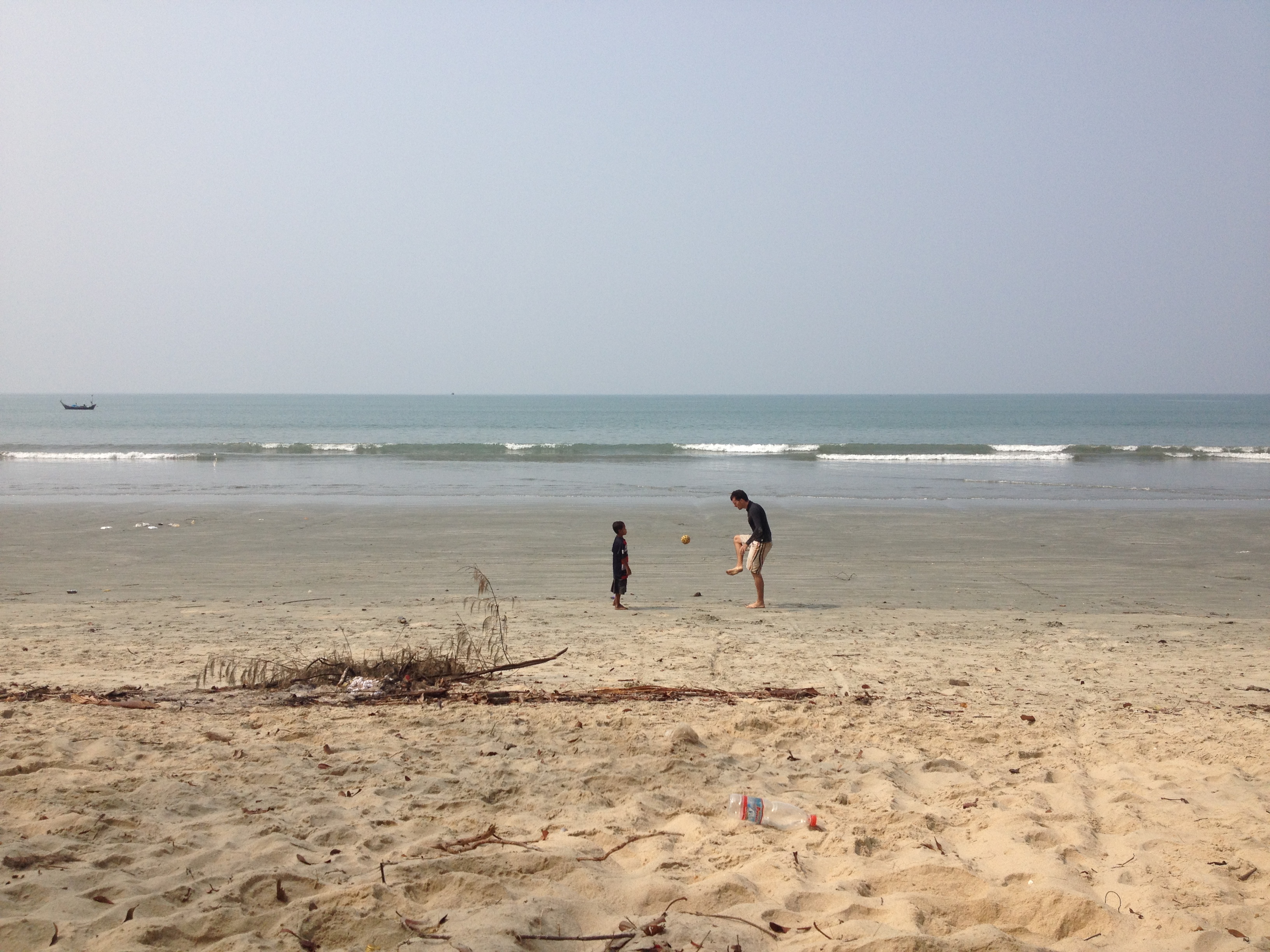
Maunmagan Beach

Sat 31 Jan 2015

Andre is from Brasil and has a PhD in philanthropy. He is one of those larger-than-life characters and makes for great company. I admire his outlook on life and how he perceives other people’s way of life.

Andre, Maja and I had breakfast at the Muslim tea house; a great place to experience a bit of local culture and good food. Rotis, naan bread, chick pea curry, fried eggs, toast, samoosas, tea and coffee. We paid about $5 in total. How do they make a profit?

Breakfast at the Muslim tea house.

We organised a tuk tuk to Maunmagan Beach, where we spent the day. I brought out the plastic ball we bought in the market and started kicking it around with a local kid. Within a few minutes some teenagers joined us and we had a good sized circle, trying to keep the ball in the air.

A local kid showing me how it's done.
A local kid showing me how it’s done.

We were the only tourists on the beach and dozens of locals asked if they could have their photo taken with us. We’re supposed to be the tourists, but we seem to be quite an attraction for the locals. I swam in the waves with the teenagers, who spoke surprisingly good English. They were all college students studying to become teachers.

We ended up having a free lunch with a group of men who took an interest in us. We joined them under the gazebo on the beach, sitting on a raised platform. They offered us different fish, sand muscles, whiskey and beer. When they saw that we wanted to buy more food with our own money, they gestured for us to sit. One man, who turned out to be a customs official, went to the back of his car and brought us more dried fish. He even organised for it to be warmed up on one of the restaurants’ fires. We communicated in broken English. When it came time for them to leave, they wished us well and went on their way. They expected nothing in return for what they had given us.

Lunch with the locals

Andre and I played football on the beach with more kids, while Maja befriended every dog she could find. Swimming in the Andaman Sea while the giant, orange sun sets in front of you and the moon rises behind, satisfies the soul.

Maja learned nothing from her rabies scare.
Football while the sun sets over the Andaman Sea.

Very Old Trains

Fri 30 Jan 2015

Yesterday was the most exciting train ride I have ever had. We ordered a taxi for 03:30am to the train station. The station was a large, very empty, old colonial building. I approached the window to buy our tickets and was asked to step inside the office. Slightly concerning as the south has only recently been open to tourists and not all the locals know this. I sat in the office while Maja stood with the bags outside. We waited for about 30 min while the cashier served the locals.He issued our upper-class tickets last. Everything is written by hand. No electronic equipment at all. While boarding the train I had a look at the lower class seats, which were solid, wooden benches. Our upper-class seats were soft chairs that had been falling apart since 1920.

Fighting the crowds at the busy train station.
Inside the old coach

I stored my rucksack overhead. The man under my bag smiled and gestured for me to tie it down. Once we got moving it became obvious why that was most necessary. The train bounced around like a donkey cart in the Transkei. I am amazed that it stayed on the tracks. At one point, however, we heard a banging sound under our carriage. It was serious enough to stop the train and have someone crawl underneath to have a look. I jumped off the train to have a look at the surroundings and watch our make-shift mechanic hitting the undercarriage with rocks. After his professional repair he came to where Maja and I were sitting and told us, “No problems!” Despite holding a massive bolt which he removed and did not replace.

Repairing the locomotive. ie. Hit it with a rock.

After a few hours we stopped in the town of Ye to change a smaller, more rickety train. The carriage was wooden and our seats were even more broken. We loved it! This felt like real travel. There were not enough seats and many people sat on the floor. A monk boarded the train and displaced a very fragile, old lady from her seat onto the hard wooden floor. I stood up and offered her my seat, but her husband and the other passengers smiled and waved me away. She ended up taking the seat of a younger woman. I later remembered reading that women are not permitted to sit higher than men.

A train station at a village along the way.

Further down the tracks we picked up a family transporting the father, who was in very bad shape.They put down a mat at our feet for the poor guy to lie on until they reached their stop. He had possibly suffered from a stroke.

As we travelled further south the number of armed soldiers increased dramatically. Most were carrying automatic rifles. One soldier was armed with a grenade launcher. I can’t imagine he would use it here, but he had enough ammunition strapped around his torso to last him a good while.

View of a village
View of a village

The local people are so friendly and seem content with life. It is hard to imagine that the country has been through much turmoil. One would expect the people to be furious and rioting. Possibly having resentment towards westerners, who were the start of their problems. The locals stop and smile when they see us. People on the platforms see us and shout and wave.  We are asked where we come from, by strangers and they say, “Welcome to Myanmar!” They do not initiate conversation in order to sell something or ask for money. They are either curious or want us to feel comfortable in their country. Alternatively, they have been instructed to do so.

At one of the stops we were joined by three soldiers and three, hand-cuffed, prisoners. They were made to sit on the floor right next to Maja and I. It would be very interesting to know how they came to be prisoners. They could have done anything from murder to promoting human rights. Rocking the boat, in all of SE Asia, is a big no no.

Further down the line Maja gave up her seat for an elderly monk. She sat on the floor, against her bag and actually found it more comfortable than the seat. There were ladies at every station, with home made food which we bought for pennies. Cooked miellies, samoosas, fried banana and other unidentifiable goods. The train stations were mainly made of a small thatch hut in the bush, with no village in sight. The larger towns would have an old colonial building at the station. I enjoyed jumping off the train to have a quick look around. Nothing but bush and a railway line. Beautiful!

Miellies on the train

During the 15 hour train journey we did not see another tourist. While sitting by the window we would be smacked in the face by branches and bamboo hanging in our path. I am tempted to jump off at one of the random little villages and stay there for a few days.

Entering Myanmar

Walking over the border from Thailand into Myanmar
Breakfast stop
Breakfast stop

Wed 28 Jan 2015

We crossed the border into Myanmar on Monday. We entered at Myawadi. The immigration official on the Myanmar side flipped through my passport and mumbled to himself, “hmmmm……..South Africa” about seven times before calling his colleague to take a look. Fortunately, I was not in trouble. I was the first South African that had crossed their border (that they knew of) and only the third African.

Seven of us formed a group in Mae Sot and we’ve travelled together into Mawlamyine. Two middle-aged British guys (I’ve forgotten their names), Marko and Igor (Italy) and Pia (Germany). Pia is just out of school and rather naive. But I remember travelling when I was 19 and I was the same or worse.

We chartered a car from Mayawadi to Mawlamyine. The first stretch of the journey was along the half-built ASEAN highway. There were dozens of checkpoints, guarded by child-soldiers who the driver had to bribe to let us through.Once off the highway the road was more rural and peaceful. We stopped in a tiny village for a roadside breakfast of vegetarian samoosas and other Indian food.

Our guesthouse in Mawlamyine is right at the river mouth.The water is chocolate-brown, which is normal for South-East Asia, but the rubbish is mind boggling! The surrounding area is beautiful, but the river bank is covered in plastic. The city is nothing spectacular. Very run down and dirty. Old colonial buildings show that westerners were once here. The atmosphere reminds me somewhat of Pemba. The local people are very friendly and quite surprised to see tourists.